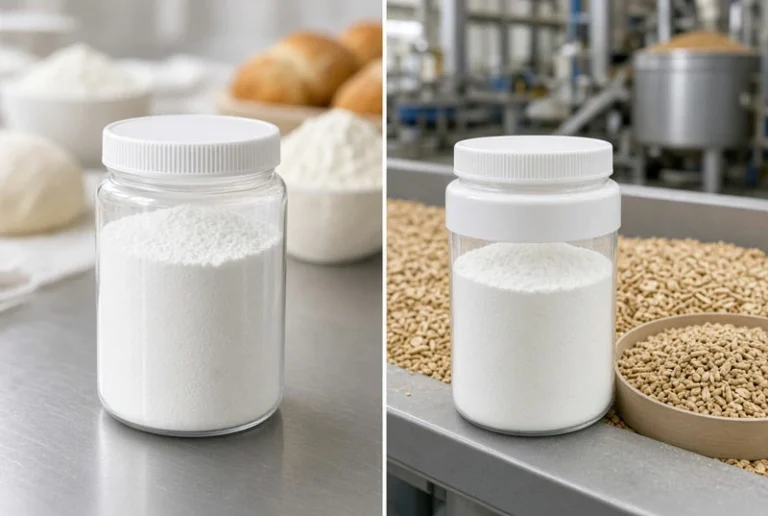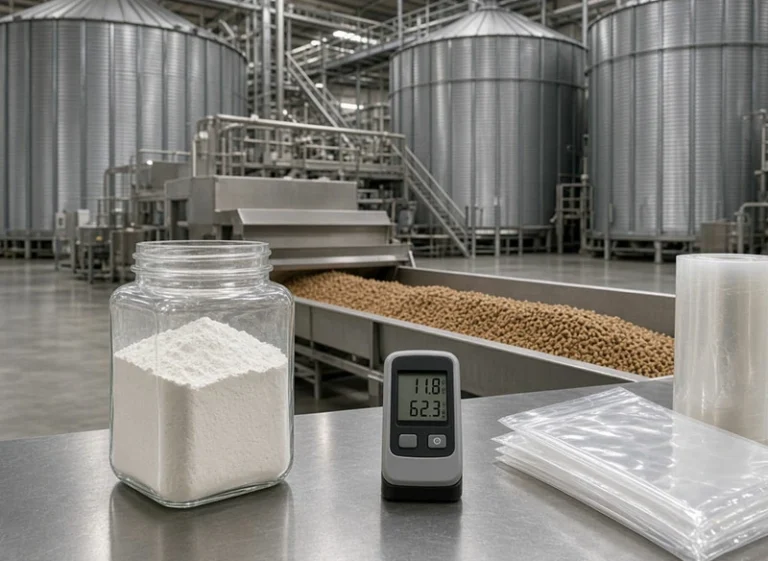

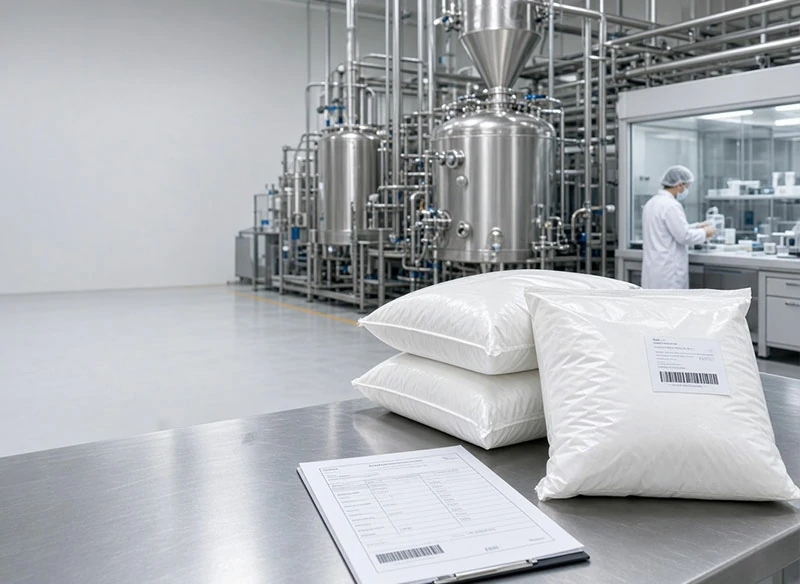
A container of calcium propionate clears customs, and the buyer’s QA team draws a sample only to find the assay falls noticeably below what the Certificate of Analysis (COA) promised — and the “manufacturer” who sold it turns out to be a trading company that sourced the batch from three different plants over the past year. This scenario occurs frequently among first-time importers, making it critical to verify who actually makes the material, not just who sells it, before sourcing calcium propionate from China. This guide covers what separates a verifiable manufacturer from a reseller, and the specific points worth checking before placing a first order.
How do you verify a calcium propionate manufacturer in China before ordering? Confirm the company operates its own production facility rather than reselling third-party output, request batch-specific Certificates of Analysis (COAs) rather than generic spec sheets, and check that certifications and registered production capacity are verifiable rather than just listed on a company profile.
China is an important sourcing market for calcium propionate used in international food and feed supply chains. Shandong Province, in particular, has a concentration of propionate, benzoate, and acetate producers, supported by established chemical park infrastructure and raw material access. However, industry sourcing platforms often list a far larger number of “suppliers” than actual manufacturing facilities. Export agents, blending operations, and trading companies frequently appear alongside genuine producers, making it essential for buyers to look beyond online profiles and verify the actual source of the material.
This gap matters more for calcium propionate than for some other commodity chemicals. The compound is produced in both food-grade and feed-grade forms from the same base chemistry, and a supplier without clear grade-specific controls sometimes fills orders from whatever batch is available rather than the one actually matching the grade ordered. Buyers who select a supplier based primarily on listed price and minimum order quantity skip that confirmation step, and they are the ones most likely to encounter the assay or documentation mismatch described above.
Most sourcing guides tell buyers to check for certifications, request a COA, and compare price quotes. Buyers often assume that if a company’s website lists ISO certificates and a production capacity figure, the company is a verified manufacturer. In reality, a listed certification or capacity number is only as reliable as the buyer’s willingness to verify it independently. A polished supplier profile and a verifiable, grade-specific production facility are not the same thing. Bridging this gap requires moving beyond basic checklists and focusing on the specific operational and documentation realities of the supply chain.
Do a company’s certifications guarantee it operates its own production facility? Not on their own. Certifications such as ISO certificates, Kosher and Halal certificates, or food-grade specification compliance claims can be genuinely held by a manufacturer — or referenced by a trading company describing a factory it sources from rather than owns. Ask the supplier directly which entity name appears on the certification documents, and cross-check that name against the company issuing the sales contract. That is a more reliable check than the certification list alone.
Verifying actual production capability is more direct than it sounds. Requesting a short video walkthrough of the specific production line, asking for the registered production scope on the business license rather than a general company profile, and checking whether the entity name on the COA matches the entity name on the sales contract are all steps a genuine manufacturer can typically satisfy without hesitation. A trading company may sometimes source similar materials, so no single check is definitive on its own — but taken together, the responses can be a useful signal of who actually controls the production.
Smaller or first-time buyers evaluating a manufacturer for a trial order often weigh a different set of priorities than large buyers placing a full-container repeat order — trial-quantity flexibility and fast sample turnaround matter more when the relationship is still unproven, while unit cost at scale matters more once a supplier relationship is established. The matrix below separates these considerations so buyers can prioritize them according to where they are in that process.

| Evaluation Criterion | What to Ask or Check | Why It Matters |
|---|---|---|
| Verified Production Capability | Business license production scope, video walkthrough of the specific line, entity name consistency across documents | Distinguishes an actual factory from a trading company reselling third-party products |
| Grade-Specific COA Documentation | Request batch-specific COAs for both food-grade and feed-grade, issued separately | A generic COA covering both grades may make it difficult to verify whether the specific batch meets the requirements of the grade being purchased |
| Certification Verifiability | Entity name on certificates matches the entity on the sales contract | Certifications listed on a website are not proof of who actually holds them |
| Sample and Trial Order Policy | Clarify the supplier’s policy on lab samples versus commercial trial orders, and who bears the international shipping costs | Small commercial trial shipments may be impractical because of cross-border logistics costs, so buyers should confirm the supplier’s sample and trial-order policy early |
| Sample and Documentation Turnaround | Time from request to receiving a lab sample plus TDS, MSDS, and COA, which varies by supplier and sample availability | Slow or incomplete documentation response is a practical early signal of how the supplier operates |
| Export Documentation Experience | Familiarity with the customs classification and paperwork for your specific destination market | Reduces the risk of port delays or documentation mismatches on the first shipment |
Buyers weighing several of these criteria at once sometimes find that a mid-sized, specialized manufacturer performs more consistently across trial flexibility and documentation responsiveness than a very large supplier optimized for full-container repeat orders, even if the large supplier has a lower headline unit price. Which set of criteria should carry more weight depends on whether the immediate goal is a trial order or a long-term repeat-volume relationship.
Buyers sourcing calcium propionate from China for the first time tend to ask a similar set of follow-up questions once they move past the general certification checklist and start evaluating a specific supplier. The answers below cover the ones that come up most often.
Ask directly which entity name appears on the certificates and the Certificate of Analysis (COA), then confirm that name matches the entity issuing your sales contract and invoice. A genuine manufacturer can also typically provide a short video walkthrough of the specific production line or share the registered production scope on their business license without hesitation. A trading company may be able to provide information about its partner factory, but buyers should then verify whether the manufacturing entity matches the entity named on the relevant documents. Inconsistent entity names across documents are the clearest red flag.
Depending on the target market and application, buyers may look for certifications such as ISO 9001, ISO 22000, FSSC 22000, Kosher, or Halal. The important point is to verify that the certificate is issued to the same legal entity that manufactures the product, rather than relying on a certification list on a company profile page.
Requesting a lab sample for testing is standard, but ordering a small commercial trial quantity before a full container depends heavily on the manufacturer’s policy. Due to high cross-border shipping costs and customs complexities, many genuine manufacturers do not support small trial orders for most countries unless the buyer has a confirmed purchasing plan and covers the logistics. It is best to clarify the sample and trial order policy, including shipping responsibilities, early in the communication process.
Turnaround varies by supplier and sample availability. Requesting the lab sample together with the Technical Data Sheet (TDS), Safety Data Sheet (SDS), and batch-specific COA gives buyers a better way to evaluate the supplier’s responsiveness and documentation practices in a single step, rather than asking for the sample first and documentation later.
Yes, many manufacturers produce both. The more relevant question is how food-grade and feed-grade production, quality control, batch identification, and documentation are managed — some suppliers use dedicated lines, while others run separate batches with distinct specifications and testing within the same system. The supplier should be able to explain how each grade is produced and verified against its applicable specification, with grade-specific COAs rather than a single output split into two labels after the fact.
It matters more than buyers often expect, particularly for a first shipment. A manufacturer with limited experience handling customs classification, packaging for ocean freight, and destination-market documentation can produce a chemically correct product and still cause a costly delay through avoidable paperwork errors. Asking how many years a supplier has exported to your specific region, rather than just globally, gives a more useful signal than production capacity alone.
For more on the product itself, or how to evaluate the grade and application fit before you get to the supplier-verification stage, the guides below cover ground this article focuses less on.
If you’re evaluating calcium propionate suppliers and want to verify production capability, grade-specific documentation, or export experience for your specific market before placing an order, our team can walk through our production setup and documentation with you directly.
Verify Our Production and Documentation on WhatsApp