

A bread batch tests moldy on day nine instead of holding to day fourteen, even though the formulation sheet lists calcium propionate E282 at the same 0.2% inclusion rate used for months. The plant’s QA team re-checks the dough pH and finds it drifted from 5.2 to 5.6 after a flour supplier change — and at that higher pH, the same calcium propionate E282 addition rate no longer delivers enough undissociated propionic acid to hold mold in check. This is the calculation gap that trips up more food manufacturers than any question about whether calcium propionate food preservative use is approved in the first place.
Calcium propionate E282 (CAS 4075-81-4) is a food preservative used mainly in bread and baked goods to inhibit mold and rope spoilage bacteria without significantly affecting yeast fermentation. Its effectiveness depends on product pH, dosage, and formulation conditions.
In food-grade form, calcium propionate E282 functions almost exclusively as a mold and rope-bacteria inhibitor in bread, rolls, and other yeast-leavened baked goods, where it controls spoilage without meaningfully slowing fermentation. It is authorized as a food additive under EU Regulation 231/2012 and under China’s GB1886.356-2022 national food safety standard, the specification detail buyers most often need to confirm before their first order.
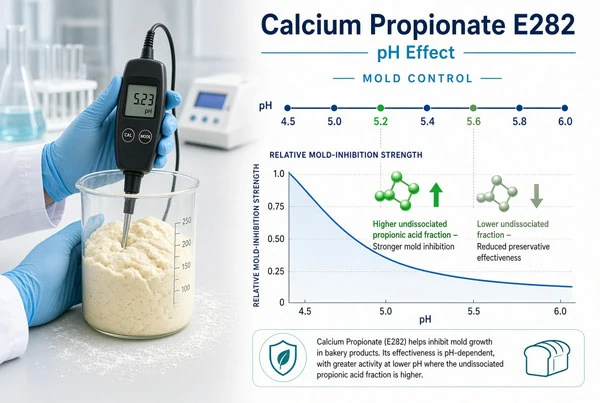
The addition rate on a formulation sheet only tells part of the story. What actually determines antimicrobial performance is the undissociated fraction of propionic acid at the product’s pH, and that fraction changes sharply within the normal pH range bread and baked goods occupy. The steps below walk through how to translate a pH reading into an addition rate that still delivers the inhibition your original formulation was validated for.
Step 1: Confirm the actual pH of your finished dough or product, not the target on the formulation sheet. Flour lot variation, water hardness, and fermentation time can shift dough pH by several tenths of a unit between batches, which is exactly the kind of drift that caused the shelf-life shortfall in the bread example above. A calibrated pH meter reading taken directly from a dough or batter sample, rather than an inferred value from raw material specifications, is the more reliable way to catch this drift before it affects finished-product performance.
Step 2: Apply the Henderson-Hasselbalch relationship to estimate the undissociated fraction at that pH. Propionic acid has a published pKa of approximately 4.87. The percentage of undissociated acid equals 100 divided by (1 plus 10 raised to the power of pH minus pKa). At pH 5.2, this works out to roughly 32% undissociated. At pH 5.6, the same equation returns roughly 16% undissociated — the fraction available to inhibit mold has been cut nearly in half from a 0.4 pH unit shift alone, even though the total propionate concentration in the dough has not changed.
The table below shows how the undissociated fraction shifts across the pH range most bread and baked-good formulations operate in, calculated using the same relationship.
| Product pH | Undissociated Propionic Acid (%) |
|---|---|
| 4.5 | ~70% |
| 5.0 | ~43% |
| 5.2 | ~32% |
| 5.4 | ~23% |
| 5.6 | ~16% |
| 5.8 | ~11% |
| 6.0 | ~7% |
Step 3: Decide whether to compensate through addition rate or through pH control. Because undissociated fraction drops non-linearly as pH rises, formulators facing a persistent pH increase generally have two options: raise the total calcium propionate E282 addition rate toward the upper end of the typical 0.1%-0.3% flour-weight range, or address the pH shift directly by adjusting a companion acidulant, such as reducing buffering ingredients or adding a small amount of an acid-forming component to the formula. Raising addition rate alone eventually runs into flavor and cost limits before it runs into a regulatory ceiling — published maximum levels for calcium propionate typically sit well above the concentrations used for taste reasons in practice, consistent with global provisions referenced in the Codex Alimentarius food additive provisions .
For example, a formulation running at roughly 0.15% addition rate at pH 5.2 delivers approximately the same absolute undissociated acid concentration as a formulation running near 0.30% addition rate at pH 5.6, since the undissociated fraction calculated in Step 2 roughly halved between those two pH values. That relationship illustrates why a modest pH drift can push a formulation from the middle of the typical addition-rate range toward its practical ceiling, leaving little room to compensate further through addition rate alone once pH continues to climb.
Step 4: Verify the calculation against the certificate of analysis for the specific batch being used, not the general product specification sheet. Assay strength for food-grade calcium propionate is specified at a minimum of 98.0% under GB1886.356-2022 (the FCC references a slightly different assay range; both figures are listed side by side in the specifications section below), and batch results commonly run higher — 99% or above is typical. A batch running near the specification floor rather than the typical result changes the effective propionic acid delivered per gram added, which matters most in formulations already operating close to the pH threshold calculated in Step 2.
Most addition-rate problems trace back to a handful of recurring errors rather than a fundamental misunderstanding of how calcium propionate E282 works. The five below come up most often in formulation troubleshooting.
Formulators sometimes validate a shelf-life target against the total percentage of calcium propionate added, then assume the same total percentage will perform identically in a different product with a different pH. It does not, because only the undissociated fraction is antimicrobially active, and that fraction is pH-dependent rather than fixed. Track pH alongside addition rate for any product where dough or batter pH is not tightly controlled, and revalidate shelf life when either changes.
A flour supplier switch, a change in water alkalinity, or a longer fermentation time can each shift dough pH without triggering any alarm in a standard QC check, since pH is rarely the parameter flagged during a supplier changeover review. Calcium propionate E282 performance quietly degrades because the undissociated fraction drops, and the mold-free shelf life shortens even though every ingredient on the label is technically correct. Building a pH check into the supplier or process change protocol catches this before it reaches a customer complaint.
Both grades of calcium propionate are held to broadly similar heavy metal limits in practice, but the assay specification differs — food grade is specified at a minimum of 98.0% under GB1886.356-2022, while feed grade is specified at a minimum of 99.0% under a separate feed-grade standard. Buyers who assume one certificate of analysis covers both applications sometimes discover the mismatch only when a customs or internal QC review asks for the grade-specific document. Requesting the COA tied to the specific grade and intended application avoids this gap.
Calcium propionate E282 performs well in yeast-leavened bread because it does not meaningfully interfere with fermentation, but the same addition rate carried over to a chemically leavened product like cake or muffin batter runs into two separate issues: these products commonly sit at a higher natural pH where undissociated acid fraction drops further, and the added calcium can interact with baking powder reactions in ways that affect texture. Retesting both antimicrobial performance and crumb structure separately avoids a reformulation cycle after the fact.
Reduced-oxygen packaging and freezing both change the microbial pressure a product faces, and formulators sometimes carry over an ambient-shelf-life addition rate without adjusting for the fact that mold is largely dormant during frozen storage but resumes activity immediately after thawing. Running a post-thaw shelf-life check alongside the standard ambient test closes this gap before it reaches a customer complaint.
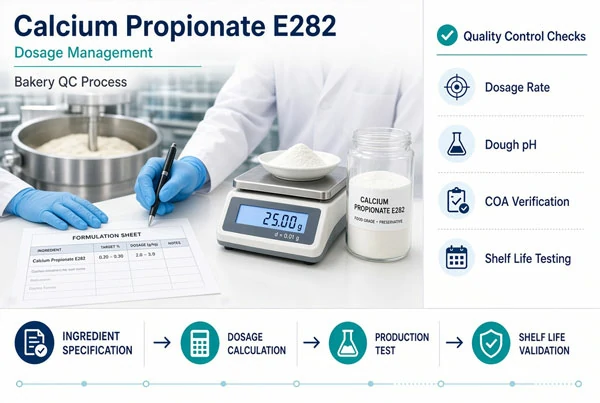
The table below shows typical food-grade parameters under China’s GB1886.356-2022 standard, alongside the internationally referenced Food Chemical Codex (FCC) purity range formulators commonly cite when specifying material from any origin. These are two separate standards, not the same figure expressed differently.
| Parameter | GB1886.356-2022 | FCC Reference Range |
|---|---|---|
| Content / Assay (dry basis) | ≥98.0%, typically 99%+ | 99.0%-100.5% |
| Loss on Drying | ≤9.5% | ≤5.0% |
| Lead (Pb) | ≤10 mg/kg | Not separately verified here |
| Arsenic (As) | ≤3 mg/kg | — |
| Calcium Contribution | approx. 21% Ca | — |
Calcium propionate E282 is recognized as Generally Recognized as Safe under FDA 21 CFR 184.1221 and authorized in the EU under Regulation 231/2012, with the European Food Safety Authority’s 2014 re-evaluation of propionates finding no safety concerns at approved use levels. Feed-grade calcium propionate, used for mold control in compound feed and silage, follows a separate specification and is covered in our dedicated Propionates Series range rather than this food-focused guide.
Sourcing tip: a specialized manufacturer producing food grade on a dedicated line, with batch-specific COA and third-party inspection available on request, is generally easier to verify against the parameters above than a trading company reselling blended-origin material — worth confirming directly with any supplier before a first order. For reference, the per-batch documentation package accompanying our food grade calcium propionate shows the COA, TDS and SDS format buyers should expect from any qualified supplier.
Buyers and formulators working with calcium propionate E282 for the first time tend to ask a similar set of questions once they move past the basic safety question and start working through an actual formulation or sourcing decision. The answers below cover the ones that come up most often.
The typical dosage of calcium propionate E282 in bread is 0.1%-0.3% based on flour weight. The exact level depends on dough pH, moisture, fermentation conditions and required shelf life.
There is no single figure that applies across all formulations, because the effective amount depends on the product’s pH as much as on the raw addition rate. Most bread and roll formulations fall within a 0.1%-0.3% flour-weight range, with the actual figure within that range set by how close the dough pH sits to the upper end of the compound’s effective range. Confirming dough pH before finalizing addition rate avoids under-dosing a product that looks correct on paper.
Yes, and combining preservatives with different mechanisms is common where a single compound cannot cover the full pH or spoilage-type range a product needs. sodium benzoate is often layered in for products that periodically drift above calcium propionate’s effective pH ceiling, while sodium diacetate preservative adds broader activity against bacteria alongside mold-focused propionate. Testing the combination at actual production pH is the more reliable way to confirm the blend performs as expected.
At the addition rates commonly used in bread, most formulators report no noticeable flavor impact, though very high inclusion levels used to compensate for a high-pH formulation can introduce a faint aftertaste before they introduce a food-safety issue. Addressing pH drift directly, rather than continuously raising addition rate, is usually the better long-term fix.
Yes, calcium propionate is an approved food additive under EU Regulation 231/2012 and is recognized as Generally Recognized as Safe under FDA 21 CFR 184.1221, with the European Food Safety Authority’s 2014 re-evaluation of propionates finding no safety concerns at approved use levels. Safety approval does not remove the need to calculate an appropriate addition rate for a specific formulation.
At minimum, request the batch-specific certificate of analysis, the technical data sheet, and the safety data sheet rather than a generic product brochure, and confirm the assay and heavy metal figures on the COA match the batch actually being shipped. A professional supplier should provide batch-specific COA, TDS and SDS documentation before shipment.
It can, indirectly. A buffering acidulant such as sodium acetate food additive affects the finished product’s pH stability, and since calcium propionate’s antimicrobial performance is pH-dependent, any ingredient that shifts or stabilizes pH changes the undissociated fraction available at a given addition rate. Recalculating the undissociated fraction after adding or changing an acidulant avoids under-estimating or over-estimating actual antimicrobial performance.
Need food grade calcium propionate E282 for bakery production? Our technical team can provide batch-specific COA, TDS, SDS and export documentation for your evaluation.
Request Calcium Propionate Specification