
A stored grain lot can look and smell completely normal while its moisture content already sits above the threshold that supports active mold growth — visual inspection alone catches spoilage only after it has already started. This is why calcium propionate remains a commonly used mold inhibitor in compound feed, silage, and grain storage. It holds that position even as newer organic acid blends compete for the same budget line. This guide compares feed grade calcium propionate against the other common options — sodium propionate, benzoic acid, and sodium benzoate — and walks through which one fits which storage and moisture scenario.
What does calcium propionate do in animal feed? It functions as a mold inhibitor, releasing propionic acid that suppresses fungal growth in compound feed, silage, and stored grain. Mold growth risk increases as grain moisture and water activity rise, with many stored grains becoming more susceptible above commonly recommended moisture limits — often cited around 14%, though the exact figure varies with grain type, temperature, and storage duration. This threshold is most often crossed after seasonal weather shifts or a change in grain sourcing — precisely the condition calcium propionate is added to control.
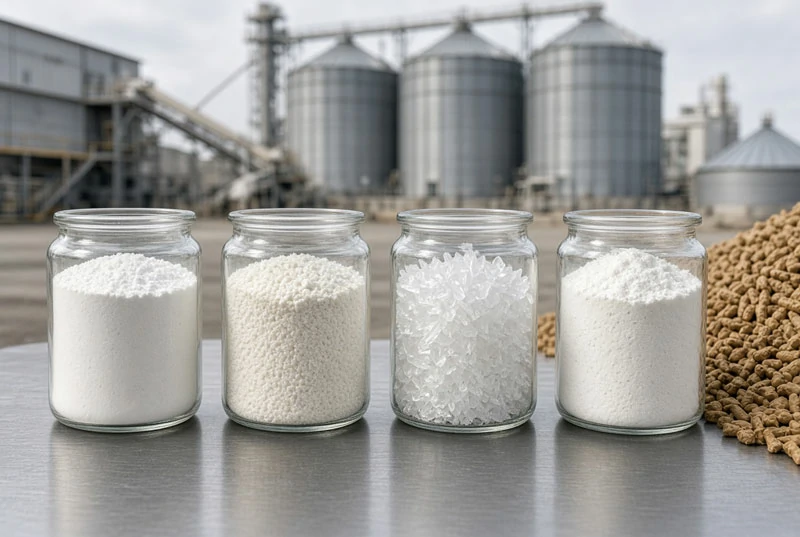
Feed mills typically choose between four organic acid salts when selecting a mold inhibitor: calcium propionate, sodium propionate, benzoic acid, and sodium benzoate. Each shares a broadly similar antimicrobial mechanism but differs enough in handling, application focus, and regulatory pathway to matter for a procurement decision. The table below compares them across the dimensions that most often drive a selection.
| Attribute | Calcium Propionate | Sodium Propionate | Benzoic Acid | Sodium Benzoate |
|---|---|---|---|---|
| Primary Mechanism | Releases propionic acid, disrupts fungal cell metabolism | Same propionic acid mechanism, sodium salt form | Antimicrobial acid active against both mold and bacteria | Sodium salt of benzoic acid, same antimicrobial spectrum |
| Physical Form / Handling | Free-flowing powder, low hygroscopicity, easier bulk storage | Powder, more hygroscopic than the calcium salt | Crystalline powder, generally low hygroscopicity | Powder, more water-soluble than benzoic acid |
| Mineral Contribution | Contributes approximately 20–21% calcium | No mineral contribution | No mineral contribution | No mineral contribution |
| Typical Feed Application Focus | Compound feed, TMR, silage, grain storage, calcium-supplemented rations | Compound feed and grain storage, similar profile to calcium propionate | Piglet starter feed as a zootechnical gut-acidifying additive in the EU, alongside general mold control | Compound feed mold control, often selected where higher water solubility is needed for premix or liquid dosing |
| Water Solubility | Moderate | Higher than calcium propionate | Low | Higher than benzoic acid |
| Typical Inclusion Rate | 1-3 kg per ton compound feed, 2-4 kg per ton silage | Comparable range, adjusted for moisture and storage duration | Application-specific, generally lower rates for the zootechnical use case than for general mold inhibition | Comparable range to benzoic acid for mold-control use |
| Regulatory Pathway (Feed) | Registered as a feed additive under standard mold-inhibitor provisions | Registered under the same general category as calcium propionate | Registered both as a mold inhibitor and, separately in the EU, as a zootechnical additive for piglets | Registered as a feed additive under standard mold-inhibitor provisions |
Both salts release the same active propionic acid once dissolved in feed moisture, so calcium propionate and sodium propionate perform similarly against mold when dosed at equivalent active propionate levels. That is why the choice between them usually comes down to handling preference and calcium nutrition needs rather than antimicrobial performance. Benzoic acid and sodium benzoate cover a broader spectrum against bacteria alongside mold. Formulators therefore sometimes select them for starter feeds or situations where bacterial contamination is a concern beyond mold alone, rather than as a direct substitute for propionate-based mold control. One caveat applies: benzoate-based inhibitors are more pH-dependent than propionates, with most antimicrobial activity expressed below roughly pH 4.5. Their broader spectrum therefore applies mainly in acidic or acidifying matrices such as starter feed, rather than unconditionally across every feed type.
Calcium propionate in animal feed does double duty in formulations for young animals: beyond mold inhibition, it functions as a supplementary calcium source in piglet and chick feed, where calcium demand is relatively high and formulators are already balancing mineral premix costs. Feed grade calcium propionate delivers this without a strong flavor penalty, which matters for palatability-sensitive starter feeds.
For straightforward compound feed and grain storage where calcium contribution is not a formulation priority, sodium propionate for animal feed is worth evaluating as a comparably priced alternative with somewhat higher water solubility, useful where the additive needs to disperse quickly into a liquid or semi-liquid feed matrix.
| Storage or Formulation Condition | Suggested Direction |
|---|---|
| High-moisture grain storage (above roughly 14% moisture) | Calcium propionate or sodium propionate, applied at the higher end of the typical inclusion range |
| Piglet or chick starter feed needing added calcium | Calcium propionate, for the combined mold-inhibition and mineral-contribution function |
| Starter feed where bacterial contamination is a concern beyond mold | feed grade benzoic acid, evaluated for its broader antimicrobial spectrum and zootechnical registration |
| Premix or liquid dosing systems requiring fast dissolution | sodium benzoate feed additive or sodium propionate, both more water-soluble than their acid or calcium-salt counterparts |
| Budget-constrained bulk compound feed with straightforward mold risk | Calcium propionate or sodium propionate, generally the lower-cost options for mold control alone |
| Silage and haylage protection | Calcium propionate, typically combined with a direct acidulant such as formic acid for complementary pH control |
Buyers evaluating more than one of these additives for side-by-side trials sometimes find it easier to source them from a single specialized propionates and benzoates producer rather than coordinating separate suppliers for each compound. With one producer, batch-specific COAs can be compared on a consistent format across the trial.
Headline assay figures look similar across most feed grade calcium propionate offers, so the practical differences between suppliers show up in documentation depth and batch-to-batch consistency rather than in the specification number itself. The checks below matter most before committing beyond a trial quantity.
These are the documents and controls applied to our feed grade batches, and the same checks we recommend applying to any prospective supplier. A reliable manufacturer will also support a side-by-side trial with sample quantities and matching COAs, so you can verify performance under your own storage conditions before scaling to a full production order.
Feed buyers and formulators comparing mold inhibitor options tend to ask a similar set of questions once they move from general research into an actual sourcing or trial decision. The answers below cover the ones that come up most often.
Not in terms of raw antimicrobial activity, since both release propionic acid through essentially the same mechanism once dissolved in feed moisture. The practical difference is handling and formulation fit: calcium propionate contributes roughly 20–21% calcium and is less hygroscopic in bulk storage, while sodium propionate dissolves somewhat more readily where fast dispersion matters more than mineral contribution. Most feed mills choose based on which of those two factors matters more for their specific formulation.
The two serve different primary purposes even though both appear in starter feed formulations. Calcium propionate is added mainly for mold control and calcium supplementation, while benzoic acid in the EU also carries a separate zootechnical registration specifically for piglets, tied to its broader antimicrobial and gut-acidifying effect rather than mold inhibition alone. Benzoic acid is not typically a direct substitute for calcium propionate in straightforward grain or compound feed storage where calcium contribution and cost matter more than the acidifying effect.
Poultry rations generally run toward the higher end of the standard range, commonly 2-3 kg per ton of feed, reflecting poultry’s relatively high calcium requirement compared with some other livestock categories. Actual rates should still be adjusted for the specific feed’s moisture content and expected storage duration rather than applied as a fixed figure across every formulation.
This depends more on your existing dosing equipment than on antimicrobial performance differences between forms. Powder-form calcium propionate suits mills with dry premix or bulk-blending systems already in place, while operations using liquid dosing lines for other additives may find a more water-soluble option, such as sodium propionate or sodium benzoate, easier to integrate without equipment changes. Retrofitting a dosing line to accommodate a preferred additive form is rarely worth the cost if a comparably effective alternative already fits existing equipment.
Yes. They may be combined in some starter feed formulations where both mold control and gut-acidifying activity are formulation goals. The two work through related but distinct mechanisms, so combining them is generally additive rather than redundant, though total organic acid loading should still be checked against palatability at higher inclusion rates. Testing the combined formulation for feed intake alongside standard shelf-life checks is worth doing before scaling a blended approach to full production.
Request the batch-specific certificate of analysis, technical data sheet, and safety data sheet before committing beyond a trial quantity, and confirm the assay and moisture figures on the COA match the actual batch being shipped rather than a general product spec sheet. Our feed grade calcium propionate is documented this way per batch, which smaller mills running a first trial before a full production order tend to find easier to verify than a blanket specification covering multiple grades.
For a broader look at calcium propionate across both food and feed applications, or for related sourcing resources, the links below cover adjacent ground this guide focuses less on.
Before committing to a full production order, it often helps to run a side-by-side trial between calcium propionate and another mold inhibitor under your actual storage conditions. Request a sample specification sheet and batch-specific COA for feed grade calcium propionate, and our team can help you set up a trial comparison against the alternative you are currently considering.
Get Feed Grade Calcium Propionate Specification & COA